My packing list – how to travel light

You can always tell a first time backpacker by the size of their bag. Overpacking is a problem, and it doesn’t have to be. Here are my tips for how to travel light enough that your backpack will pass as carry on luggage with most major airlines. This list is designed for city travel with some countryside, not hardcore trekking. So no tent, hiking boots, or sleeping bag.

Clothing

You never need as much as you think. It’s better to have to pick something up than discard things along the way. One of the biggest mistakes I’ve made travelling was buying a wardrobe just for that trip, before I went there. I bought with the climate in mind (I was going to South America) rather than my own personal taste. If you wouldn’t wear it at home, you’re not going to enjoy wearing it while travelling.

Don’t bring: clothes that are only useful for clubbing. So no heels or sparkly and impractical dresses. They take up a lot of room, and you just won’t get the use from them to justify it.

Do bring: clothes that go from day to night. Shorts with a nice top, maxi dresses, and little black dresses that are casual enough for day wear too are all good choices.

Don’t bring: jeans. Jeans are heavy, impractical, often quite uncomfortable to wear for a long time, and they take forever to dry.

Do bring: leggings. Leggings are the traveller’s secret weapon. They can go under shorts to keep you warm, they’re comfortable on a hike, and they can also be worn at night in a hostel or at a couchsurfer’s for some modesty. They pack small and they dry fast. I usually travel with 2 pairs.

Don’t bring: a million accessories. I hope this one goes without saying, but you just don’t need 5 different choices of scarves and hats.

Do bring: a versatile scarf that you love. Try to find one that can double as a shawl when it gets cold. If it’s colourful it will make all your outfits instantly brighter.

Don’t bring: impractical footwear, new footwear, and shoes that don’t dry and absorb water fast. If it rains and your only walking shoes get soaked you’re going to have nothing to wear tomorrow. Or you’ll have wet feet, which will make you sick, and being sick when away from home is miserable.

Do bring: a comfortable pair of shoes that can withstand miles of city walking and light hikes, and a pair of flats or sandals that are small and light and will transition from day to night effortlessly.

Weird tip: I met a woman in Colombia who swore by traveling with thongs. I tried it and she was right. If you can stand them, they’re smaller, pack better, and dry faster than regular underwear.

Toiletries

Don’t bring: bottles, they’re heavy, space consuming, and they don’t last.

Do bring: bars. You can get solid bars of soap, shampoo and conditioner. They’re airplane friendly, they don’t take up space and they last for ages. You can also use your soap to wash your clothes with in a sink, if necessary.

Don’t bring: all your make up.

Do bring: essentials and one extra thing. I travel with basic make up: spf foundation/BB cream, mascara, eyeliner, blush. My one extra is a bold red lipstick for the evening, as it instantly detracts attention from travel-worn clothes.

Don’t bring: a hairdryer. Most places have them to rent.

Do bring: straighteners, at least if you have crazy frizzy hair like mine that triples in size when humidity is mentioned. Having nice hair makes such a difference to my mood, and my willingness to appear in travel photos.

Electronics and extras

Don’t bring: all your chargers. This is a massive space waster.

Do bring: cables that will fit multiple things. Some cameras and most electronics will charge via usb, and usbs will go into laptops, meaning you only need your laptop charger to go into the wall –  this means you only need one bulky charger.

Don’t bring: your big laptop, if you can avoid it.

Do bring: a netbook or a tablet. Much better than nothing, as it saves using slow hostel computers and it means you can blog, send couchsurf requests, and upload your photos from the road. Battery life is also much better than most large laptops.

Don’t bring: paper books.

Do bring: a kindle/ereader. I was so against them until I got one. Now I can’t imagine traveling without it. It saves space and gives you choice of what to read.

The bag

Don’t bring: a suitcase, or anything with wheels.

Do bring: something you can comfortably carry on your bag for hours, and something good quality. A good bag is worth investing in, as it will accompany you on the road for years. Find something with a waist strap that fits you well: taking the weight off your back is crucial.

My current favourite travel buys

Lush shampoo and conditioner bars

At about $12 each they’re not cheap, but 1 1/2 of these got me through 3 months of travelling in South America, and my hair smelled amazing and was soft and clean.

Buy them here. They’re also almost all vegan, and they’re all cruelty free.
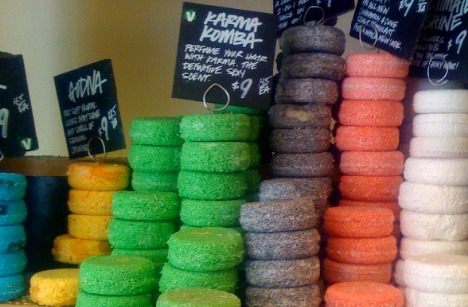
Image credit: Valli Ravindran/Flickr.com

Image credit: Valli Ravindran/Flickr.com

Croc sandals

These are without a doubt the best thing I bought before I came to Taiwan. If you’re going to a hot, wet country, buy these. They’re incredibly comfortable, not un-stylish (they don’t look like crocs) and they’re durable and totally waterproof. I can wear them in a typhoon in summer, and it’s no problem.
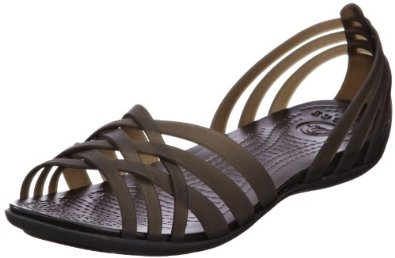
Picture from Amazon.com, where you can also buy the shoe http://www.amazon.co.uk/Crocs-Huarache-Womens-Ballet-Flats/dp/B008KZC5KK

Picture from Amazon.com, where you can also buy the shoe http://www.amazon.co.uk/Crocs-Huarache-Womens-Ballet-Flats/dp/B008KZC5KK
Share this:

How to travel as a vegan (and a reaction to Anthony Bourdain)

I’ve hitch-hiked, couchsurfed, camped, stayed in hostels lived in more than a few countries. All as a vegan. Unsurprisingly, when I started eating a plant-based diet it was one of the things I worried about most, as I already loved travel. I wouldn’t say that I had an opinion as extreme as Anthony Bourdain (an opinionated chef) in my pre-vegan days, but the motives behind refusing hospitality weren’t exactly ones I understood. Here’s a taste of his eloquent, beautifully phrased sentiments:

“They make for bad travelers and bad guests. The notion that before you even set out to go to Thailand, you say, ‘I’m not interested,’ or you’re unwilling to try things that people take so personally and are so proud of and so generous with, I don’t understand that, and I think it’s rude. You’re at Grandma’s house, you eat what Grandma serves you.”

You think that’s bad? Here’s what he says about vegans:

“Being a vegan is a first-world phenomenon, completely self-indulgent.”

Excuse me while I go into the corner until I stop laughing. This statement is so ironic to me that I can’t even take it as an insult. For the record, though, I don’t eat what my Grandma cooks when I visit. I cook her vegan food, and even though she complains a little, she eats it and I’m pretty sure enjoys it.

I was worried about seeming like a bad guest, though. I’ve done some thinking since then. When was the last time you saw an article called ‘reasons Jews and Muslims are bad travellers because it’s not Kosher and Halal.’ (Opinions on Halal meat, again, save for another day.) The difference being, religious diets often hold a respect that vegetarian/vegan ones don’t. I’m still waiting to see an article called ‘Why the Buddha makes a bad traveler and guest, and if he visits me he’ll eat beef and thank me for being generous.’ Think that’s going to happen?

Probably not.

What Bourdain handily looks past is that respect it a two way street. When I travel I am more than open to immersing myself in their culture, their language, and their food. As long as no animals are harmed. And I hope that they can respect that, just as I in turn respect their religions and customs. So far the only people who it seems to offend… are those sitting at home.

wpid-img_20130403_133817.jpg wpid-img_20141003_203346.jpg wpid-img_20140616_143601.jpg wpid-img_20130911_221428.jpg

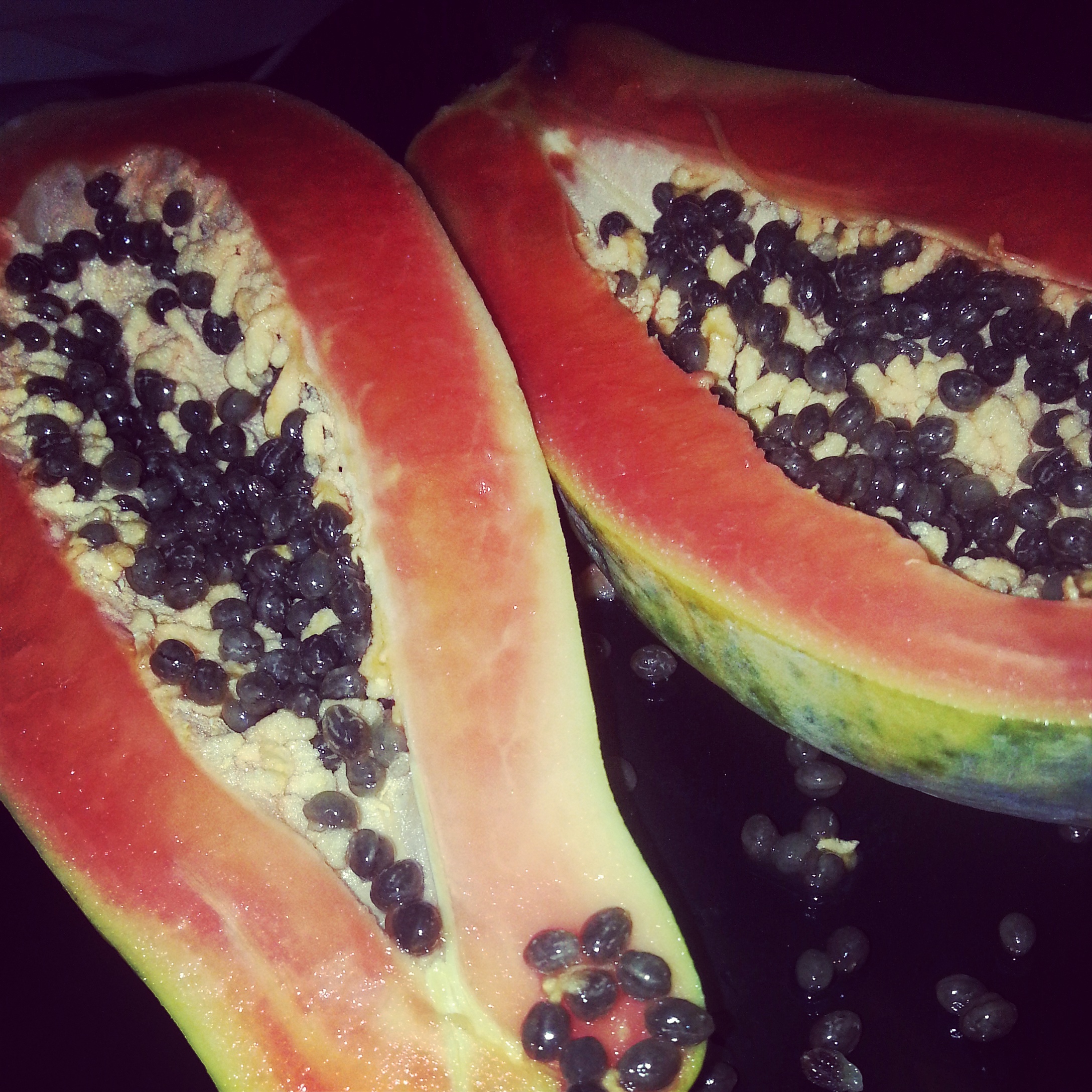
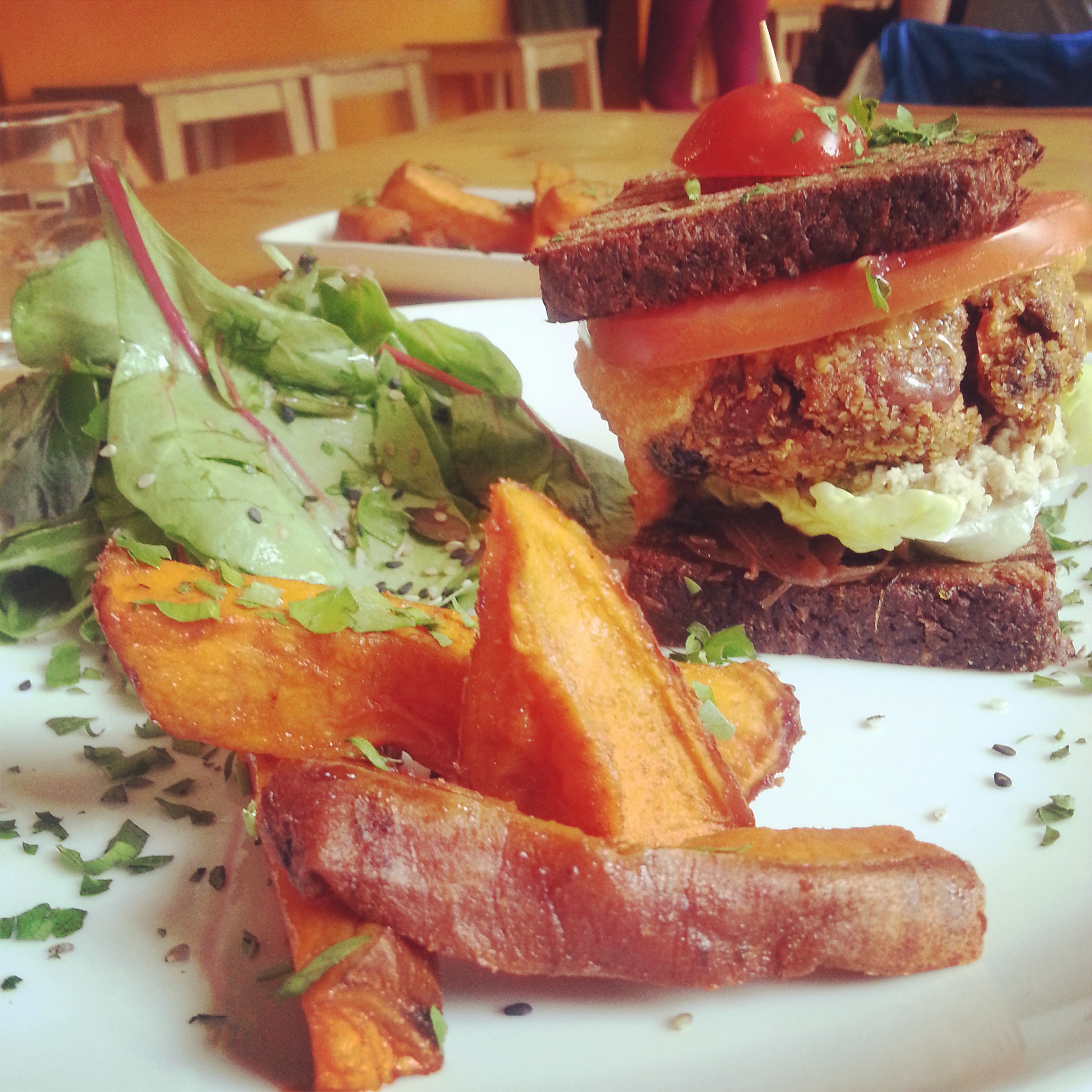
Top to bottom, left to right: a ‘haggis’ and cranberry panini at a cafe on an island in the North of Scotland, a ripe papaya for dinner in Taiwan, an extortionately expensive raw vegan patty burger in London, and an amazing traditional style thing in Brno, Czech Republic.

How to eat when you’re a broke vegan travelling

Emergency food I travel with in my bag:

Rye bread (if possible, easy to find in Europe, not so in Asia), peanut butter, vegetable spreads/pates, bananas, apples, trail-mix and/or nuts. Sometimes there’s also a potato and an onion in there to cook at a host’s.

A standard day’s food on the road:

Breakfast: Fruit of some sort, usually bananas. I’ll add in bread or have oatmeal if I’m feeling super hungry.

Lunch: Some restaurants will have a vegetable soup, often I can find something involving noodles. I can usually find fruit or veg, or peanut butter and crackers when all else fails.

Dinner: Happy Cow is a godsend. I can usually find somewhere in any city I’m in that does vegan food. If I’m cooking, I’ll often do a potato/onion/mushroom/tofu fry up which is quick, cheap, and I can find the ingredients almost anywhere in the world. I carry small bags of spices in my backpack to add, carefully packaged.

I’m not good at being hungry. And I like hot meals. Couchsurfing is usual for travelling as a vegan because I can often find at least a vegetarian to stay with, or the person is willing to translate when we go out for food so I know what I’m eating.

The main thing is prepare, prepare, prepare. Make sure you have a few granola/cliff bars stashed away, so that when an emergency happens you’re okay. I’m a purist within reason, too – if there’s bread on offer, I’ll check it’s not been friend in lard or something, but I’m often a little more flexible about it containing milk or egg if I can’t tell and there’s nothing else. Chances are, it’s vegan. Better that than something that definitely has animal products in it.

Bottom line is, I’ve made it this far. And it only gets easier to travel as a vegan. It shouldn’t be a reason to put you off – veganism or travelling. And vegan food tourism is a fantastic way to see a city. Hunting down that little vegan place down a back alley in a city leads you past amazing places that you might never have experienced had you settled for the omni-place on the high-street. There are ways, there are means, and there are rewards.

P.s., here’s the full Anthony Bourdain article if you feel like it.

Share this:

The New Year resolution revolution.

Today a woman stopped me in the street on my way out of the metro, as I was trying to cross the road to get to my apartment, and food. “Do you know how to be happy?” she asked, smiling unnaturally and handing me a flier. I’ve been homesick all week thanks to working Christmas, I haven’t had a day off other than Sundays in several months, and I’m going through an ‘I hate my job, I’d rather be anywhere else but here’ phase. It will pass, but strangely enough when my blood sugar is on a downward spiral and there’s a strange woman keeping me from my food… that’s not something I remember.

I think I may have muttered ‘no,’ rather offishly, and looked pointedly at the lights willing them to change.

She handed me a leaflet: ‘Keys to a Happy Life.’ As I walked up the stairs I realised she was a Jehovah’s Witness. They’ve made it to Asia now? Where do I have to move to escape them?

Which, of course, has me thinking about happiness. My personal happiness project has slipped a little this month, thanks to aforementioned burn out and lack of festive spirits. I’ve been mainly focusing on getting out bed in the morning, and on not crying at work when a kid makes my life difficult on Christmas day, and I look on Facebook to see friends and family having Christmas as it should be. Whatever, it’s been hard, but it’s not like I ever thought it would be easy.

Onwards and upwards, and here comes 2015. There are many arguments for why New Year’s resolutions don’t work. The easiest comparison to make about them is that they’re like diets. They’re a short-term fix rather than a lifestyle change, and people quickly slip and pile back on the pounds, or the broken resolutions. Here’s a link that will send you to a study on New Year’s Resolutions, with the statistics that 60% of them fail, mainly after the first week. A plethora of articles across the internet advise making small changes that are attainable. This seems logical enough. But I’m going to go back to the Happiness Project here for inspiration, or what I termed my ‘Buddhism Project‘.

Sure, setting a small goal may be easier to keep, but it’s also easier to discard. I like the idea of stepped changes. Like Gretchen Rubin adds a new set of changes every month, I like to have an end goal that is fairly considerable, but broken down into manageable steps. Losing a total of 40 pounds can be broken down into 3-5pounds a month, for instance, which is achievable and also allows room for failure on one or two of the months.

Another article, published only about 15 hours earlier than this blog post, says that New Year’s resolutions are procrastinating something you should be starting today. Sure, if it’s losing weight or quitting smoking maybe. I personally like the idea of a concrete date to make a change, though, and here’s where the revolution aspect of resolutions comes in: using the last few days of the old year to properly take time to reflect on your life is valuable time to think over what realistically needs changing, and how to do it. I like the word revolution for its double meaning: typically we think of revolutions as an uprising against a political power, but the word originally come from the Latin ‘revolutio,’ meaning turn around. A new year is a fresh start, a revolution, or a turn around. A reason to look at what hasn’t been working, and what has been working but could work better. I like to think of it as a chance to refocus: to look at where I’ve gone off track this year, and to work on pulling things back in.

For me, this year has been somewhat stale. This may seem odd as I’ve graduated and moved to Asia in 2014, but in terms of having a direction in life I’ve actually backtracked. This was mainly due to a messy break up and my somewhat rash decision to flee the country when, excuse the phrase, I was so confused about what was happening in my life that I couldn’t tell my arse from my elbow. Suddenly I was in Taiwan going ‘how did I get here? What?’ Strangely enough, this is a common story here. In many ways this year has been a huge turning point in my life, but most of it has been spent trying to figure things out, remembering how to be alone, getting good at being alone again, losing the ability, regaining it, and dealing with a full time job involving lots of very very small humans who don’t speak my language.

In conclusion, I’m currently working on my list of New Year’s resolutions. Nowhere does losing weight feature, or quitting smoking. I don’t smoke so that’s a no-brainer, but you get the principle. My main challenge is to be more productive with my time, so that I can manage to fit a life of my own in around my job. I’m starting with getting up earlier. Not much earlier, just an hour or so. Then I’ll try and be productive in that hour. Then I’m going to get up a little earlier still until I can fit in a decent amount of exercise, or a blog post, or some Chinese. I’ve been working on phasing out TV series’ (on my laptop, I haven’t watched an actual TV in a long time) for a while. It’s going pretty well, but then it’s an ongoing process, not sudden cold Turkey.

While there’s no reason not to do this throughout the year, I personally like the concrete milestone provided by the New Year, and the inevitable reflection on the past year that we all find ourselves doing. I don’t believe New Year’s resolutions are worthless, or procrastination. They’re a way of starting as you mean to go on, of staging a revolution against what isn’t working, and of turning around and refocusing the things that are but could do better.

Share this:

Can I stay on your couch, stranger? Being homeless travelling.

My flat in Taipei doesn’t have heating. It’s COLD. I could buy a heater, but I’m not really at home enough to justify the expense. Three weeks ago it was still beautiful weather, and so a friend and decided to go to the beach before it turned wintery again. For the first time in my life, I stayed in a hotel. I’ve always worked to earn money to travel before, but I’ve never earned enough to afford luxuries.

Three and a half years ago I came back from being in South America for three months exhilarated by travel and looking for any way possible to continue my wanderings. So I started using couchsurfing (www.couchsurfing.org) much to the disgust of my flatmates, who definitely weren’t fans of strange men and women off the streets who smelled a bit funky (generally the first thing they do, and certainly the first thing I always do is ask to take a shower) wandering into our kitchen and being given cups of tea. The three particularly wonderful things about couchsurfing are that it drastically cuts your travel budget, it can make traveling alone a much less lonely experience, and it can show you a far more real side of the city than the one you see otherwise. A hostel in Europe costs around $15-25 a night, depending on the city, and that’s for the cheapest dorm room where you’ll be sardined in with a lot of other travellers. You’ll probably be eating out, because cooking a hostel is awkward, even if they do have a kitchen. This adds another $10-20 a day, if you’re eating cheaply but with okay nutritional content (I’m not counting the travellers I know live on bread and that’s it).

If you couchsurf, though, you’re looking at a free bed. And often the use of a kitchen, so you can make proper food and have a proper food budget. It’s nice to cook for your host or take them for a meal, but that doesn’t blow the budget if you’re staying for a couple of nights. This takes the daily bed and board budget from around $40 to $10 a day. Suddenly, travelling between terms as a student when you have no money becomes possible again.

Except for when you don’t have a bed, and spending money on a hostel seems to not only be an extreme waste of money by this stage, but also has a sense of failure to it. There’s something anticlimactic about saying ‘I couchsurfed right down to the southernmost point of Crimea, except for the night when I couldn’t be bothered to send requests so just stayed in a hostel’ (I couchsurfed all the way, that’s another story).

This has left me in the awkward situation of being bedless and roof-over-headless, with nothing working out at the last minute like it usually does. Three times to count, in Krakow… Krakow again, and Salzburg. The first time I pulled the solo female traveller card that I very rarely do and don’t really respect myself for doing – I hung around in a club until I found someone who would let me sleep on his couch. I emphasised that I just wanted to sleep on his couch. He seemed very confused about what was going on, but acquiesced. This may seem shady, but one of my cardinal rules of travelling alone is don’t drink much if I don’t have someone I trust around, and don’t do any sort of substances. I don’t ever want to lose control of myself and not know what happened.

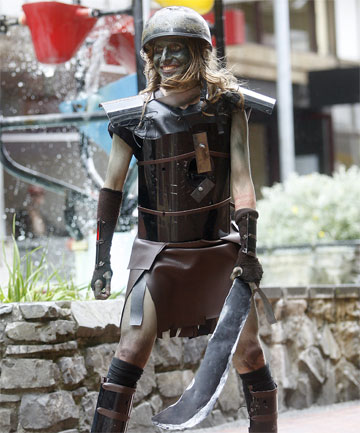
The next night I still didn’t have somewhere to sleep, and I decided to spend my day on a  free walking tour. This is a fantastic way to see a city, and I completely recommend it if you’re ever in Krakow or any other city that does them. Worrying idly about not having a bed, I began to pay more attention to our guide. He seemed pretty eccentric. Very eccentric. ‘Do you couch surf?’ I asked. ‘Of course!’ he replied, ‘I love crazy people!’ It seemed legitimate. ‘Do you have a spare couch tonight? I couldn’t find a host.’ ‘Of course! Meet me outside the Mosque at 8, we’re going drinking first.’ And so it was that after the walking tour I joined him and a few others from the walking tour for a pub crawl. I learned a bit more about my host while we were downing rainbow shots of vodka that were more sugar than alcohol, including the information that he was a Lord of the Rings fanatic. So much so that he moved to New Zealand and hung around the streets trying to score a part in the Hobbit movie. You can read an article about it here: http://www.odt.co.nz/news/queenstown-lakes/194741/all-days-work-goblin

6223902

My host in Krakow, Poland. He looked a little different at that time.

That night I and two lovely girls from Andorra stayed in his bedsit apartment with him, one of the girls and I in the bed, the other on the sofa bed with him. There was a lot of giggling from the bed, but I’d had a little too much cherry vodka and fell fast asleep while the party carried on around me.

The next day I went to stay with an actual host from couchsurfing who had finally accepted.

A year later I was in Munich, and heading to Salzburg, hitchhiking with my then boyfriend. There’s a noticeable difference in how easy it is to find a host when you’re two people. I know myself I like to host solo travellers much more than couples or friends travelling together, mainly because I feel I get to know them much better. I also feel more bound to help out solo travellers in a fix, and I’m sure that one of the reasons I get hosted so easily when travelling alone is that people feel the same way. One person without a bed inspires far more sympathy than two.

As we were waiting at a gas station by the border of Austria and Germany, I got a message from a woman called Bambi. Bambi said she would be able to host us, and we should let her know when we got to Salzburg. ‘See!’ I triumphantly told my boyfriend, ‘I told you things always work out!’ He muttered something and sloped off to smoke down a nearby bank again. It was cold, and had been raining for hours, and we were soaked because we’d been standing there for hours. This gas station was failing us miserably, and we’d been offered rides to everywhere except Salzburg. In retrospect, we should have taken one of them.

Finally a young man in an ancient and battered VW pulled up and told us to get in. It had been an hour and I hadn’t had a reply from Bambi, but I wasn’t worrying too much yet. He told us he was about to study Sports Sciences, and he was staying overnight with a family friend. We vaguely attempted to score a couch, but it clearly wasn’t going to happen. He dropped us off at a motorway station on the edge of the city so that I could get wifi and see if there was any word from Bambi. It was now very late, about 11pm. I was starting to worry a little. Sure enough, no word. ‘Let’s walk into the city centre at least,’ I suggested. ‘It might give her a little more time to reply.’ My boyfriend didn’t seem optimistic, but agreed. The rain had at least gone off a little.

We found shelter in one of the only places still open: the bar of a boutique hotel. I ordered a cup of tea to warm up with, and he ordered a beer and went outside to stress smoke frequently. A group of middle aged and plummy accented English business men came in and sat down at the table next to us, shooting odd looks across from time to time. We were two very, very scruffy bedraggled hitchhikers, with limp cardboard signs to previous destinations strapped to our bags, sitting in very civilised surroundings. I’m not sure I’ve ever felt as rough and out of place as I did then.

It was now 12.30am, and still no word from Bambi. The barman was beginning to shoot us annoyed looks, so we left and went back to roaming the streets. We found a hostel and tried to convince them to let us have one bed between the two of us, but they wouldn’t and at 18 euro a night, we weren’t willing to get one each. We found some Koreans outside the hostel, but they really weren’t much help and we didn’t thing we could smuggle ourselves in amongst them. They also didn’t seem to speak any English, as became evident after us talking about them well within earshot for a considerable amount of time raised no reaction.

The Koreans went inside, and we got bored and wandered off. We found a very shady Gentleman’s club, and a cat that danced when I stroked its back. We got rained on again. Unlike Taiwan, where there are also elderlies on bicycles, Berlin, where there are always pervy Turkish men, and Glasgow, where there are a lot of drunks, Salzburg is completely deserted at night. And I mean completely. We saw absolutely nobody in our two hours of wandering. It’s that civilised that people go to bed at 10pm and stay in bed.

We went back to the 24hour McDonalds, but it wasn’t 24hour, it was 12am-7am. I used their wifi for just long enough to establish that we could hitch out first thing and a South American would be able to host us in Vienna. We just needed somewhere for that night. Briefly, we considered pitching our tent in a park, as we had done by a gas station in Munich. But this was in a considerably more built up area, and I suspected that drifters probably wouldn’t go down too well.

At last, we found a house that was having heavy amounts of construction work done. Clearly no one was living there: the yard was rubble, but it did have an empty shed. Desperate, freezing, and at 2.30am in the morning, we crept in to escape the harsh wind, curled up, and went to sleep. Unfortunately I get vivid dreams when I’m stressed that lead to me sleepwalking and sleeptalking, so I had a nightmare that a man with a torch had found us. I woke up shouting ‘there are people beneath us!’ Another time I shivered so violently that I shook myself awake.

At 6am when it started to get light we crept out and back to the McDonalds, where we loitered outside waiting for it to open. At 6.30 a strange assortment of hipster Austrian business men wandered along too, and paced up and down outside in their pinstripe suits that stopped a few inches above their ankles, and their floppy half-shorn haircuts, glaring at their watches. When McDonalds opened we and the hipsters dashed inside for the heat and the coffee. We regrouped. I have never had a worse night of sleep in my life. We went outside. I put out my thumb by the side of the road, and I held up a sign saying ‘Vienna’, and we got the hell out of Salzburg.

Salzburg. The picture here couldn’t be further from my experience of the city.

And hopefully, those will be the last stories of homelessness I will ever have to tell. This stay in a hotel has marked a new chapter in my life of travel. While I’m sure I’ll rough it many more times, I now at least can pay for a hotel when I’m in a bind, and not have to resort to breaking and entering.

Share this:

My time on Public transport in Ukraine, or why you should always talk to strangers.

As I’m not actually travelling at the moment, I think it’s time I finally start uploading some of my travel stories from the past – reliving the glory days, if you will. Where better to start than with the story I told at a story slam. You can find the radio broadcasted version here: http://www.icrt.com.tw/wordpress/blog/2014/11/27/heresay-episode-4-tune-in-thursday-night-at-9pm-for-the-show/#.VJPd3_A0N8

I’m up first on the broadcast.
This is a tale of why you should never turn down conversations with strangers when on public transport while travelling. Within reason of course, don’t follow them down any back allies. One morning I woke up on a shelf, which was my bed, in a third class cabin on a train in Ukraine. It was one of those days, you know? The cabin was a long corridor with shelves about yay across that I was very close to rolling off. For some reason it was mainly Russian Babushkas and their granddaughters who all rose with the crack of dawn and started eating homegrown apples, drinking the black tea with lemon the train provided, and reading newspapers.

Of course, this woke me up. I hadn’t had the best night’s sleep: possibly something to do with sleeping on a tiny swaying shelf two metres off the floor with elderlies snoring in 5 part harmonies all around me. And I was surrounded by Russian. I was addled, and tired, and I desperately needed to find a toilet. So I wandered off down the carriage to where a load of men with bellies and hair poking out of their string vests were standing laughing. And pointing. At me. And my feet. What?

“Where you from?” The bristliest of them bellows at me.
“The UK,” I replied.
“CRAZY ENGLISH!” He shouts down the entire carriage, slapping his friends.
“Huh?”
“Shoes!” He points to the bathroom floor, and then to my feet. I’m wearing socks. This makes them crack up, helpless with laughter. “Come, my wife will meet you,” he tells me, and pulls me back down the carriage, ignoring my need to use the facilities. His wife spoke excellent English, which was rare in Ukraine. While she gave me the contact details of their family hotel and pressured me to visit and bring my parents, her husband and his Polish friend told filthy stories to each other, selectively translated by the wife, until at one point the man turns to his wife and says something in Russian.

“He wants me to tell you,” she says, “that we have two sons, who are very nice, and handsome, and earn good money.” She looks troubled. “But I don’t know why he wants me to tell you this as they both have girls…”

So that was how I nearly became a Russian bride, but moving on…

I was on a bus in Crimea, and struggling, as usual, with the language barrier. My host that night, a friend of a friend, was telling me I needed to get off the bus in the middle of nowhere. I put him on to the driver so they could speak Russian, and the driver was, if anything, more confused than me. As luck would have it the woman next to be could speak English and she sorted everything out with the driver. She told me that her husband was ‘Bob Skinner’, and that he was a Yorkshireman, from England. He lives with her and her daughter on their goat farm in the Crimean hillside.

“Other men, they make me do all the work. Bob he treat me so well, he make me feel beautiful, like a woman.”

She stayed with me until I had met my host, because she didn’t trust him (he was perfectly lovely, and that’s another story) and took my phone number so that she could ring me later and check up on me.

Later that night I got a phone call from Bob, who was very excited that his wife had met the first British girl he had ever heard of being in Crimea, and he’d been here for over five years. He really does spend all his days farming goats, with only one other house in walking distance. I have an open invitation to visit and farm goats with them.

As I hope has been shown, the moral of this story is that when in strange lands you should never be put off talking to strangers out of fear that they may be foe, not friends. If life starts to fail me, I can always go to Ukraine, safe in the knowledge that I have a husband and goat farming waiting for me.

(Image from BBC news, http://news.bbc.co.uk/2/hi/programmes/fast_track/9727345.stm)

Share this: